

What is that AI thing and is it all about chatbots?
If knowledge is power, then knowing what AI really is should be crucial. Unfortunately, many think of AI as only ChatGPT. There is more to AI than that.
Jack Lampka
7/19/20263 min read
Which one of these AI forms is the best?
That was a trick question. There is no such a thing as THE best AI form, model, or solution. It always depends on the business needs. These business needs will drive which AI is best to address them. Sometimes AI may be even an overkill, when a simple dashboard or rules-based automation system can sufficiently address your business problem.
Whichever AI ends up being the right choice for your business needs, don’t think of AI as a technology. Think of AI as a solution to your business problems. Think of it as the means to reduce expenses or increase revenues.
This approach will also help you with bringing AI to your employees. Don’t give them a new tool and expect them to figure out which business problems that tool can address. Instead, engage employees in brainstorming how AI could solve the specific challenges they face every day. If they co-create the AI solution, they will embrace it from day one.
How can employees embrace AI?
They need to understand it. The better people understand how something works, the more willing they are to use it. If you want your employees to use AI, you need to make sure they understand what it is.
Is artificial intelligence all about ChatGPT? Or Arnold Schwarzenegger’s Terminator? Or those product recommendations you have been getting from your online retailer for over twenty years? It’s all of these, and more.
Unfortunately, the current hype causes most people, including executives and business leaders, to focus on tools such as ChatGPT. This is an example of Generative AI, which has been available for years, but became a household name when the first usable AI chatbot, ChatGPT, was launched in 2022. The other form of AI, Analytical AI, which lately has been often ignored, has been used by companies for decades.
So then, really, what is artificial intelligence?
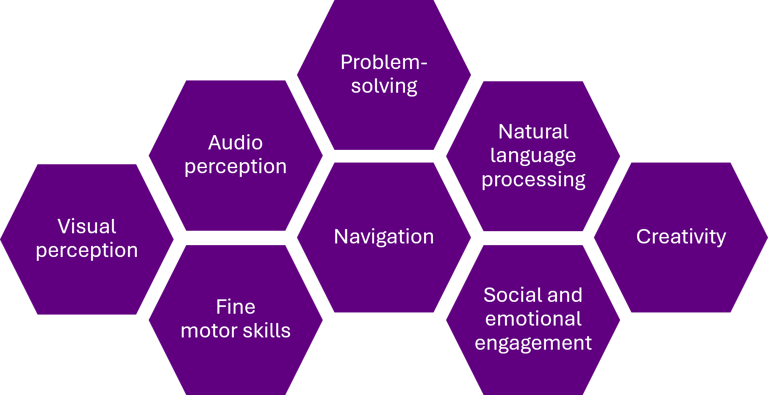
Artificial intelligence (AI) is the machine's ability to perform cognitive functions we associate with humans. These cognitive functions are more than just the algorithms of natural language processing that Large Language Models (LLM), such as ChatGPT, focus on. For the purpose of artificial intelligence, experts consider the eight cognitive functions:
Visual perception
Audio perception
Fine motor skills
Problem-solving
Navigation
Natural language processing
Social & emotional engagement
Creativity
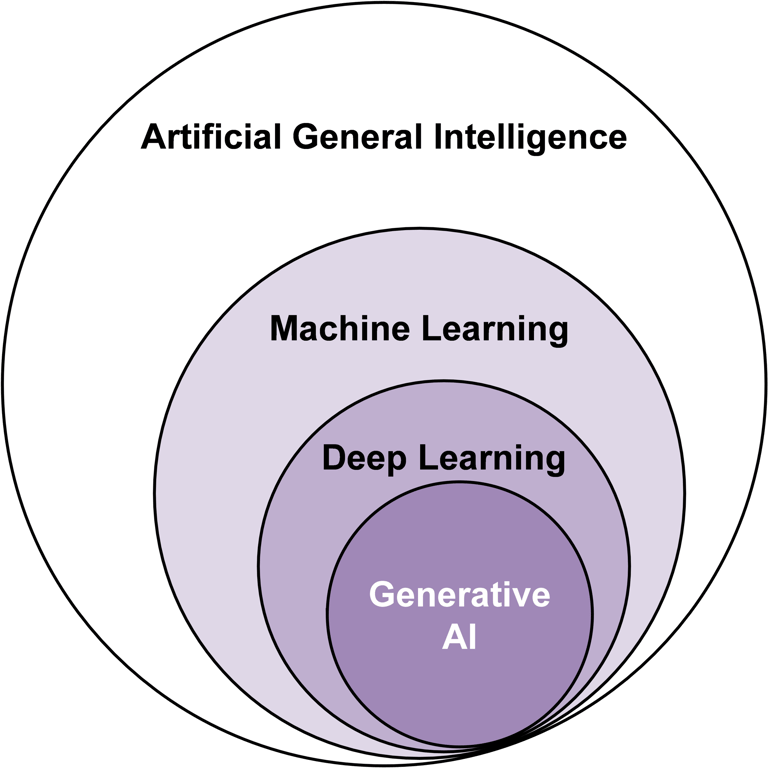
In order to carry out these cognitive functions, the machine needs to have a data-based mathematical model of reality to be able to process and understand this reality. Algorithms try then to replicate reality as closely as possible. This leads to several forms of AI, based on the complexity of these algorithms and which cognitive functions they focus on.
Artificial General Intelligence (AGI), or “broad AI,” refers to machines capable of performing all cognitive functions at or beyond human levels. While AGI doesn't exist yet, it is a long-term goal in AI development. To match humans, an AGI system must master all eight cognitive functions. These include interpreting complex environments, understanding unsaid context, navigating autonomously, and demonstrating empathy.
Machine Learning (ML), also known as “narrow AI,” is a form of AI that is already widely used. It enables machines to learn from data and perform specific tasks like pattern recognition and prediction. Examples include Amazon’s product recommendations and Google Maps' navigation. These tools apply ML to problem-solving and navigation using past behaviors and human-provided guidance such as maps.
Deep Learning (DL) is an advanced version of Machine Learning that uses neural networks to analyze complex data with minimal human input. It powers systems like autonomous driving and robotics. These applications involve several cognitive functions to be addressed at once. For autonomous driving, this includes visual perception, audio perception, problem solving, and navigation. In robotics, Deep Learning supports precise movement and navigation.
Generative AI (GenAI), the new kid on the block, is a subset of Deep Learning. It uses large neural networks to generate text, images, and more. While its business value has still to materialize, GenAI excels in summarizing content, analyzing large text volumes, and creating training videos. It addresses natural language processing, emotional engagement, and - depending on one’s view - creativity, but it still lacks true contextual understanding and originality.
For a more detailed explanation of AI, including history and deep dives into these four forms of AI, check out McKinsey’s “What is AI”.
📧 speaker@lampka.com 📞DE +49 176 47678552 📞US +1 971-966-1015
© Copyright. All rights reserved. Data privacy. Impressum.