

Why is Generative AI today’s hammer?
AI vendors are pushing chatbots as the only AI tool, as the proverbial hammer. But there is more to AI than chatbots. Much more.
Jack Lampka
7/26/20264 min read
Let’s come back to the hammer. Would you hire a plumber to fix your leaking bathroom fixtures if his only tool were a hammer? How about a hammer with a magnifying glass? Or with a folding knife on the side?
No matter how enhanced the hammer is, I wouldn’t.
I would look for an expert that understands the problem, knows the tool options, and applies the proper tool for that particular problem.
Why should that be different with AI?
Since AI is much more than chatbots, companies need to look beyond Generative AI for successful AI adoption.
Why should companies look beyond Generative AI for meaningful AI adoption?
Mark Twain is attributed saying "To a man with a hammer, everything looks like a nail." If your tool kit has only hammers, you may end up treating every problem as a nail. And it doesn’t matter how many hammers you have, how fast they are, how cheap they are, how many parameters they have, and how the Chinese ones supposedly outperform US ones. It’s still a hammer.
Yes, I’m talking about AI chatbots.
This is how many companies treat these AI chatbots today. Because they have first encountered AI through ChatGPT, one of the GenAI chatbots, they treat AI chatbots as the only AI solution available. The constant product releases and updates from tech vendors also lead to high (social) media attention and the perception that GenAI is the only solution. GenAI is that hammer today.
At the same time, the expected business value from Generative AI is overhyped. There are only a FEW of industries with heavy content creation that financially benefit from Generative AI, such as the film and the advertising industries. Analytical AI solutions, on the other hand, have been implemented and proven to work in ALL industries and business functions. Analytical AI are solutions based on machine learning and deep learning that innovative companies have been using for decades.
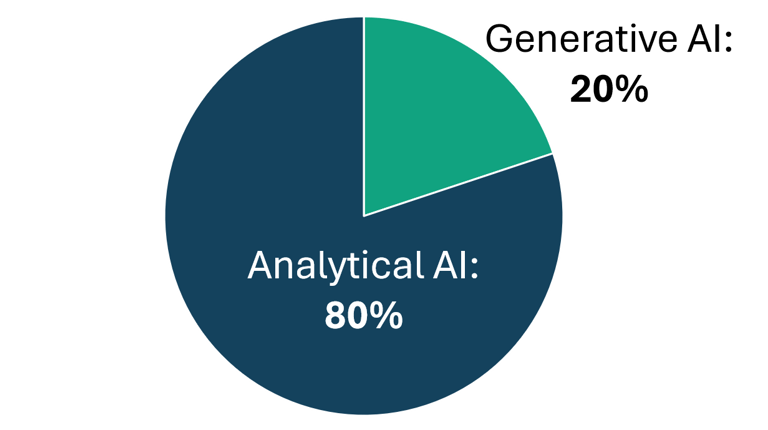
McKinsey expects Generative AI to deliver only 20% of the overall value that AI can deliver for companies. 80% of the business value that AI delivers comes from Analytical AI.
AI is the machine's ability to perform cognitive functions we associate with humans. One of these cognitive functions is natural language processing. OpenAI, the company beyond ChatGPT, and other AI vendors have almost perfected replicating this human cognitive function in chatbots. But that’s chatbots’ main focus.
Another cognitive function is problem solving. Problem solving has been tackled by machines through machine learning, a subset of Analytical AI.
Which activity do you think is the most common business task? Natural language processing, so analysis and generation of text, or problem solving? This partly explains why 80% of the AI value comes from Analytical AI.
Despite all of this, chatbot vendors mainly ignore Analytical AI.
Why do chatbot vendors ignore Analytical AI?
At least three explanations come to my mind.
1️⃣ First, billions of US dollars have been invested in chatbot vendors with the focus on Generative AI. Their investors expect high returns. It would be detrimental to admit that chatbots are only adding a small business value. This is true especially now since some of these companies, e.g., Open AI and Anthropic, are planning IPOs. So, they stick to chatbots as the only AI.
2️⃣ Second, while being stuck on the path of making chatbots bigger, faster, and cheaper, AI vendors pursue the holy grail of Artificial General Intelligence (AGI). They chase what is technically possible, instead of what is practical for business.
3️⃣ And third, Analytical AI solutions are decentralized. They are developed in-house by internal data teams, based on the company’s private data. Chatbots, on the other hand, are centralized since only a few companies have the capacity to train these models. And, these chatbots are trained on public data. The business model of AI vendors relies on this centralized approach. Hence, they keep focusing on chatbots as the only way to use AI.
All of that leads to the ongoing propaganda that AI chatbots are the universal AI to solve all business problems and everybody with a chatbot can do it.
I experience how successful that propaganda is on a regular basis. Recently, I talked about AI with a business consultant who recommends GenAI for his clients. I talked about the different forms of AI and how many businesses are still unaware of the financial benefits that Analytical AI delivers. What surprised me was the suggestion from the consultant to use a chatbot to create Analytical AI solutions for companies.
Apparently now business consultants have been primed by OpenAI & Co to ignore the fact that data is the key driver of AI. They believe that you can use AI chatbots trained on public data to address a company-specific business problem, which requires private company data.
They don’t understand that there is only limited value companies can gain from GenAI, which is built on publicly available information. An AI chatbot trained only on public data cannot magically deliver SPECIFIC recommendations for increasing revenues or reducing expenses for YOUR company.
What are the differences between Analytical AI and Generative AI?
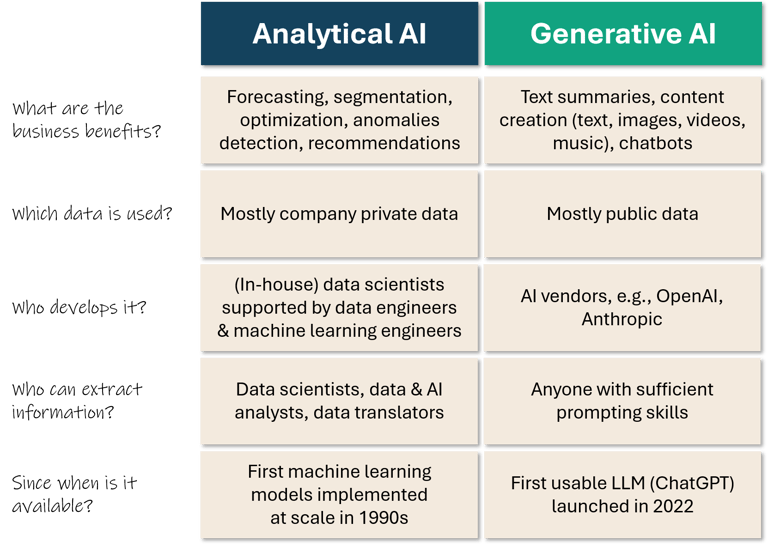
Here is a summary of the different aspects relevant to understanding and using Analytical AI and Generative AI.
What are the business benefits?
Analytical AI: Forecasting, segmentation, optimization, anomalies detection, recommendations
Generative AI: Text summaries, content creation (text, images, videos, music), chatbots
Which data is used?
Analytical AI: Mostly company private dataGenerative AI: Mostly public data
Who develops it?
Analytical AI: (In-house) data scientists supported by data engineers & machine learning engineers
Generative AI: AI vendors, e.g., OpenAI, Anthropic
Who can extract information?
Analytical AI: Data scientists, data & AI analysts, data translators
Generative AI: Anyone with sufficient prompting skills
Since when is it available?
Analytical AI: First machine learning models implemented at scale in 1990s
Generative AI: First usable LLM (ChatGPT) launched in 2022
📧 speaker@lampka.com 📞DE +49 176 47678552 📞US +1 971-966-1015
© Copyright. All rights reserved. Data privacy. Impressum.